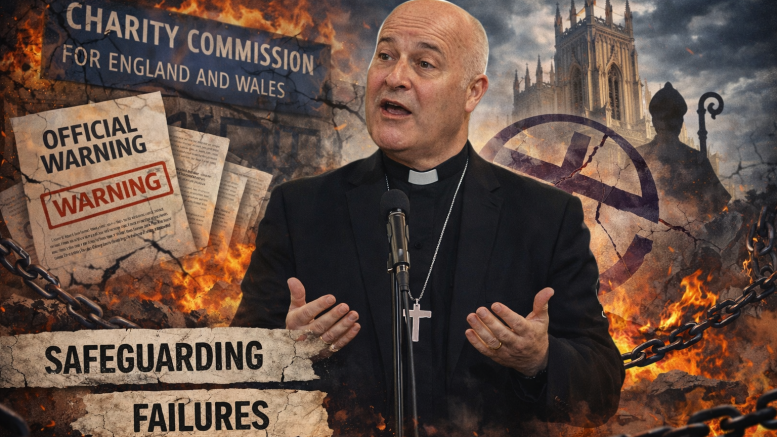
The Charity Commission’s Official Warnings to the Liverpool and Chelmsford Diocesan Boards of Finance – the legal bodies that make up the Church of England in those areas – mark a moment of profound significance for the Church of England. For the first time, as far as I am aware, the regulator has concluded that Church bodies committed mismanagement in their handling of safeguarding concerns – this time relating to allegations against the former Bishop of Liverpool, Dr John Perumbalath.
These warnings are not technicalities. They expose deep structural weaknesses in the Church’s safeguarding culture, governance, and leadership. And they raise unavoidable questions about the role of the Archbishop of York, Stephen Cottrell, who – through his positions as Metropolitan, Chair of the Archbishops’ Council, and Chair of the House of Bishops – has had unparalleled responsibility for driving safeguarding reform.
What the Charity Commission found
The Commission’s warnings to Liverpool and Chelmsford identify clear governance failures:
- Liverpool: Trustees “failed to consider or investigate” a safeguarding complaint against Bishop Perumbalath and did not ensure that risks were properly assessed or reported.
- Chelmsford: Trustees failed over a period of “about two years” to report a serious safeguarding incident relating to a complaint made in 2023 about Perumbalath’s conduct during his earlier ministry in the diocese.
Both dioceses have issued statements acknowledging shortcomings. Liverpool’s trustees explicitly accept that they “did not adequately discharge their safeguarding responsibilities”. Chelmsford disputes some of the Commission’s conclusions but accepts the need for stronger trustee oversight.
The regulator’s findings are stark: trustees were not given the information they needed, and safeguarding concerns were not handled in line with charity law.
This is not an isolated failure. It is part of a pattern.
The structural problem: Safeguarding in the shadows
The Church of England’s safeguarding system is structurally flawed – I am not the only person or organisation who has been saying this for years. Investigations and decisions are routinely handled in private by:
- Bishops
- Archbishops
- The Archbishops’ Council
- The National Safeguarding Team
These bodies operate with limited transparency, limited external scrutiny, and – crucially – no statutory independence. Time and again, independent reviews, survivor testimonies, and media investigations have shown that this system fails those it is meant to protect.
The Church of England will point to its INEQE safeguarding audits as evidence of external scrutiny – as it repeatedly does to suggest that their actions are scrutinised. INEQE has not published audits for either Liverpool or Chelmsford. Liverpool’s audit is scheduled for the coming weeks. No date is given for Chelmsford’s audit.
Survivors and campaigners have long criticised INEQE’s methodology for relying heavily on diocesan self‑assessment and for failing to engage meaningfully with victims. The Charity Commission’s findings now underline the limitations of that approach. Where INEQE tends to produce reassuring, institution‑friendly commentary, the statutory regulator has identified serious mismanagement, inadequate processes, and a lack of trustee oversight.
The contrast could not be clearer: the Church’s preferred auditing model is simply not capable of detecting the failures that the Charity Commission has now exposed. Instead, the Charity Commission’s warnings confirm what many have long argued: the Church’s internal safeguarding structures are not fit for purpose.
1. Trustees are kept in the dark
In both dioceses, trustees were unaware of key safeguarding concerns. This is not unusual. Across the Church, safeguarding cases involving clergy – especially senior clergy – are handled privately by bishops and the NST. Trustees cannot fulfil their legal duties if they are not informed.
2. Bishops hold too much unchecked power
Bishops are simultaneously:
- Pastoral leaders
- Line managers
- Public representatives
- Decision‑makers in safeguarding cases
This creates unavoidable conflicts of interest. When allegations involve senior clergy – or bishops themselves –the system becomes even more compromised.
3. The NST is not independent
The National Safeguarding Team reports to the Archbishops’ Council, not to an external regulator. It operates within the same hierarchical culture that has repeatedly failed survivors.
4. The Archbishops’ Council has been formally criticised
In November 2025, the Charity Commission issued a public admonishment stating that the Archbishops’ Council must “rapidly accelerate safeguarding reforms” because progress was too slow and governance was inadequate.
That Council is chaired by Stephen Cottrell.
Stephen Cottrell’s leadership: A fair and necessary critique
This is not about personal attacks. It is about leadership, governance, and accountability.
Stephen Cottrell has repeatedly presented himself as the figure who will transform safeguarding in the Church of England. In public statements, he has said:
- “We are committed to creating a safer Church.”
- “We will learn from past mistakes.”
- “We will rebuild trust.”
Yet under his leadership:
- The Archbishops’ Council has been formally criticised by the Charity Commission for slow and inadequate safeguarding reform.
- The House of Bishops has failed to deliver the independent safeguarding structures repeatedly promised to survivors.
- General Synod has been given partial or delayed information about safeguarding controversies, with key documents withheld or heavily controlled.
- The Church continues to rely on internal processes that lack independence, transparency, and credibility.
As Archbishop of York, Cottrell is not responsible for every operational failure. But he is responsible for:
- The culture of safeguarding leadership
- The pace of reform
- The transparency of national governance
- The oversight of the NST
- The information given to Synod
- The direction of the Archbishops’ Council
The Charity Commission’s warnings land squarely within his sphere of responsibility.
Trustees: The legal risks you now face
Trustees of Church of England bodies – members of bishop’s councils or Diocesan Board of Finance executive committees – are legally responsible for safeguarding. The Charity Commission has now made it clear that:
- Trustees cannot delegate safeguarding oversight to bishops or the NST.
- Trustees cannot rely on being “kept informed” – they must insist on information.
- Trustees must ensure that serious incidents are reported promptly.
- Trustees must challenge inadequate processes.
- Trustees may face personal regulatory consequences if they fail to act.
If trustees sit back and allow safeguarding to be mismanaged by bishops, archbishops, the Archbishops’ Council, or the NST, they risk:
- Regulatory action
- Disqualification
- Reputational damage
- Scrutiny from statutory agencies
The era of assuming “the bishop handles safeguarding” is over.
The path forward: Independent, statutory safeguarding
The Charity Commission’s intervention makes one thing clear: the Church cannot continue to police itself.
A statutory, independent safeguarding body is now essential. It would:
- Remove conflicts of interest
- Ensure trustees receive the information they need
- Provide consistent standards across dioceses
- Restore public trust
- Protect vulnerable people
- Protect trustees from being placed in impossible positions
This reform has been promised for years. Under Stephen Cottrell’s leadership, it has not been delivered.
Leadership must be accountable
The Charity Commission’s warnings are not just about two dioceses. They are about a national safeguarding culture that has failed repeatedly – and about leadership that has not delivered the reform it promised.
Stephen Cottrell has held the most senior safeguarding leadership roles in the Church of England. He has chaired the bodies responsible for reform. He has controlled what Synod sees and does not see. He has spoken of transformation, but the regulator now finds mismanagement in dioceses connected to the system he oversees.
This is not a personal attack. It is a fair, evidence‑based assessment of leadership.
The Church of England cannot rebuild trust without accountability. And accountability must begin at the top.
A Church that has received two unprecedented Charity Commission warnings cannot credibly rebuild trust while the same leadership structures – and the same leaders – remain in place.
Stephen Cottrell has chaired the Archbishops’ Council through repeated regulatory criticism, overseen a safeguarding system that still operates in secrecy, and promised transformation that has simply not materialised. These are not questions of personal morality; they are questions of governance, judgement, and public responsibility.
At some point, leadership must be accountable for the culture it has shaped and the failures that have occurred under its watch. That moment has now arrived. For the sake of survivors, for the integrity of the Church, and for the credibility of the reforms that must follow, Stephen Cottrell should step aside.





Lots of people have experienced grim evidence of what is being described above. Disregard for national law, and fundamental or agreed Anglican Church principles, is rife. Paradoxically, a now largely secular UK state has been profoundly shaped by biblical principles of natural justice, yet one place exists where these principles are visibly disregarded a great deal of the time: the Anglican Church. Hard to believe!
REV CANON DR WILLIAM GEORGE NEELY died in 2009 and is buried by an entrance to Armagh’s Anglican Cathedral . A Dec 21 2025 newspaper report showed the deceased paedophile’s flat tombstone which ends with three words in block capitals [PRIEST SHEPHERD FRIEND]. Why can the Irish national Primate, Archbishop John McDowell, not come clean and name Neely as a paedophile, so that a sinister 50 year cover up of child abuse finally ends?