The Archbishops’ Council’s latest safeguarding paper to the General Synod is not merely inadequate. It is offensive.
Offensive not because it is clumsily written, or because it lacks polish, or even because it is complacent in tone. It is offensive because it has been produced, approved, and circulated as if the last six months had not happened at all.
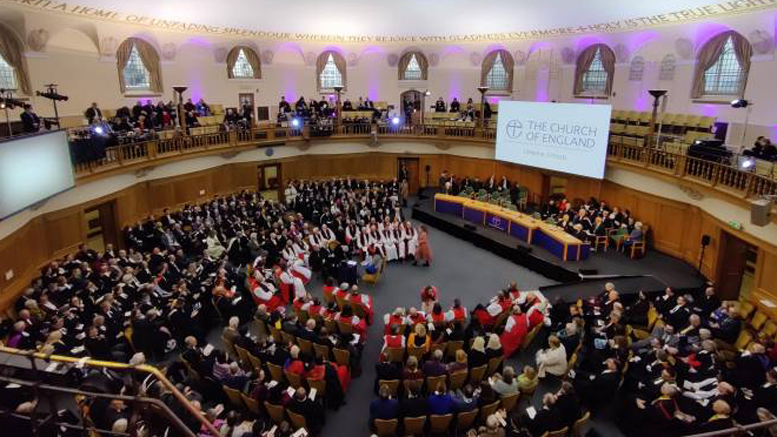
The paper, a GS Misc report authored by the Council’s Director of Safeguarding, Alexander Kubeyinje, and dated “February 2026”, is not due to be debated. It is not scheduled for discussion. It will simply be placed before Synod and noted. And it offers a breezy account of progress, improvement, and confidence in direction at precisely the moment when confidence has collapsed.
That dissonance is not accidental. It is institutional.
Since the last meeting of General Synod, the Charity Commission has issued a formal rebuke to the Archbishops’ Council itself and official warnings to two Church of England charities. Those warnings are unprecedented in the modern history of the Church. They are not misunderstandings. They are regulatory findings of mismanagement in safeguarding.
In the same period, it emerged that an abuse survivor, known publicly as “N”, had a complaint about the Bishop of London improperly set aside by Archbishops’ Council staff, in direct contravention of the Church’s own safeguarding rules, requiring the matter to be reopened. That is not historic failure. That is recent practice.
At the same time, Parliament has rejected the draft Clergy Conduct Measure, citing fundamental concerns about secrecy, lack of transparency, and the inability to assess safeguarding consequences. Questions are now being asked in Parliament about whether the Archbishops’ Council is capable of handling safeguarding at all.
And yet, the Director of Safeguarding reports to Synod with a paper that reads as if none of this exists.
So the question must be asked plainly: is this institutional blindness? Or is it institutional contempt?
A report that gaslights survivors
Safeguarding reports are not neutral documents. They do not land in a vacuum. They are read by survivors, by victims, by advocates, by campaigners, and by those still trapped in Church processes. To write, at this moment, a report that foregrounds how well things are going is not merely tone-deaf. It is actively harmful.
It tells survivors that what they have experienced does not matter. It tells them that regulatory findings of failure are footnotes. It tells them that Parliament’s rejection of Church legislation is an inconvenience, not a warning.
If this is the best the Archbishops’ Council can produce after the last year, then the problem is not communications. It is governance.
The Director of Safeguarding may be the author, but this document did not emerge unexamined. It would have been read by senior staff. It would have been cleared. It would have been authorised for circulation. And that means it passed across the desk of the Secretary General, William Nye.
William Nye is not a bystander in this. He is not a junior official. He is the chief executive of the Archbishops’ Council and the secretary to its trustees. He understands governance. He understands regulatory risk. He understands, better than most, how this paper would be received by survivors and by the wider public if they were aware of it.
Which raises an unavoidable question: how did this paper come to be approved?
Blindness, cynicism, or something worse?
There are only three plausible explanations.
The first is that the Director of Safeguarding is so institutionally embedded that he is genuinely unable to see the scale of failure around him. That would be alarming in itself.
The second is that the Archbishops’ Council as a whole is institutionally blind: so insulated from consequence that regulatory warnings, reopened complaints, and parliamentary rejection barely register.
The third is more troubling still: that this paper is a deliberate act of defiance. A not-very-subtle message to Synod that says, in effect: things are bad; we know they are bad; you know they are bad; we know that you know they are bad — and we are going to carry on as if nothing is wrong.
If that is the case, then this is not incompetence. It is contempt.
And if the Secretary General knowingly allowed this paper to go forward, then responsibility rests with him as much as with its author.
Throwing someone under the bus?
There is another possibility, which should trouble Synod deeply.
Is this paper designed to fail?
Is the Alexander Kubeyinje being positioned as the public face of a narrative that senior leadership knows is indefensible — a convenient figure to be sacrificed when the backlash inevitably comes? That would be a familiar pattern: responsibility pushed downwards, accountability retained upwards.
If that is what is happening, it is cynical in the extreme. And if it is not, then the alternative is no less damning: that senior leadership genuinely believed this report was appropriate.
Either way, it speaks to a catastrophic failure of judgment at the centre of the Church.
Where are the trustees?
The Archbishops’ Council is a charity. Its members are trustees with individual legal duties: duties to act prudently, to avoid harm, and to ensure that the charity does not mislead those it affects.
So trustees must now ask themselves some very direct questions.
Did they know that the Director of Safeguarding intended to present such a report to Synod at this moment?
Did they know that the Secretary General would approve its circulation?
Did they consider the risk of harm to victims and survivors from a paper that presents a falsely reassuring picture?
And if they did not know — why not?
Trustees cannot hide behind process. Regulatory warnings have already made clear that passive governance is not acceptable. Silence is not neutrality. It is complicity.
Time for resignations
At this point, calls for “learning lessons” are an insult.
If a safeguarding director can produce a report this detached from reality, then he should not remain in post. If a Secretary General can approve its distribution in the aftermath of regulatory rebuke and parliamentary rejection, then he should not remain in post either.
This is not about punishment. It is about credibility.
Safeguarding cannot be led by people who are unable — or unwilling — to acknowledge failure when it is staring them in the face. It cannot be overseen by governance structures that respond to crisis with denial.
Resignations, or dismissals, are not acts of aggression. They are acknowledgements that leadership has failed and that trust has been broken.
Synod should not let this pass
General Synod should not allow this paper to be “noted” and forgotten. Members should ask why it was written, why it was approved, and why it bears so little relation to reality.
And the wider Church should ask a harder question still: if this is what the Archbishops’ Council is willing to say to its own Synod, what does it say behind closed doors?
Because one thing is now painfully clear.
The problem is not that the Church does not know how bad things are.
The problem is that those in charge appear determined to behave as if it does not matter.


It I difficult to know which of the alternative explanations is correct. A carefully drafted Quextion at the forthcoming Synod session should be tabled.