This site exists because the Church of England has failed to tell the truth about itself.
For years, churchabuse.uk has documented safeguarding failures, institutional defensiveness, procedural injustice and the routine prioritisation of reputation over people. Much of that work has been done through blog posts: immediate, reactive, often written in response to breaking developments or first-hand testimony.
That work will continue. It is essential.
But it is not sufficient on its own.
Blog posts are designed for immediacy. They respond to events as they unfold. They challenge statements, expose contradictions, and record failures in real time. What they are not designed to do is provide a stable, long-lasting factual foundation that can be relied on months or years later by people trying to understand how Church systems actually work.
That is why I am now publishing formal background briefings.
What the briefings are – and what they are not
The briefings are intended to sit alongside this site, not replace it.
They are not opinion pieces. They are not campaign leaflets. They are not “explainers” written to flatter institutional narratives. They are structured, evidence-based documents that set out how particular systems, legal frameworks or decision-making processes operate, and why those structures produce the outcomes they do.
They are written to be durable.
A blog post is often anchored to a moment: a Synod debate, a report, a court hearing, a press statement. A briefing is designed to remain useful long after that moment has passed. It should still make sense when quoted by a journalist, read by a parliamentarian, used by a survivor trying to understand a process, or relied upon by someone encountering these issues for the first time.
In short, blog posts deal with events. Briefings deal with architecture.
They exist because one of the Church of England’s most effective defensive strategies is fragmentation: scattering responsibility across Measures, rules, guidance, committees, working groups and unpublished conventions until accountability dissolves. Briefings pull those strands together in one place.
Why launch them now?
Because the same patterns keep repeating.
Every few years, the Church announces reform. Every few years, it insists that lessons have been learned. And every few years, survivors find themselves confronting the same secrecy, the same lack of independence, the same procedural barriers, dressed up in new language.
That is not an accident. It is the product of how power is structured.
If reform is to be meaningful, it has to be informed by an understanding of the systems that shape outcomes regardless of intent. That requires more than commentary. It requires clear, accessible, factual accounts that do not rely on institutional goodwill or selective disclosure.
The briefings are an attempt to provide that.
Why these two briefings first?
Although the briefing series is intended to range widely – across safeguarding, governance, accountability, redress and institutional power – the first two published briefings focus on issues that are foundational.
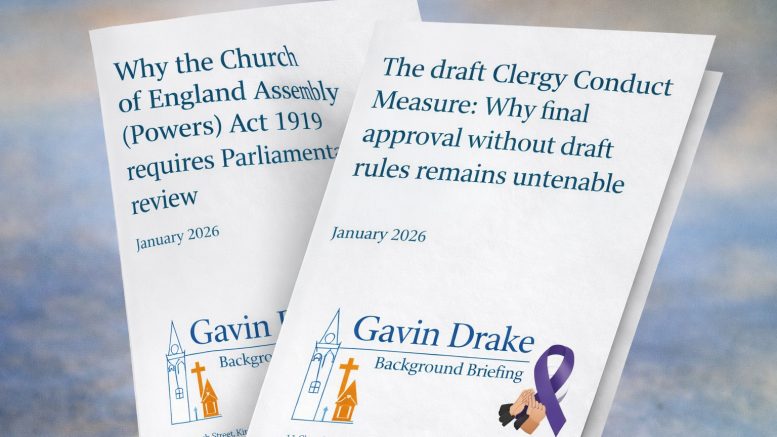
The first examines the Church of England Assembly (Powers) Act 1919: the constitutional framework that governs how Church legislation acquires the force of an Act of Parliament. This is not an abstract constitutional curiosity. It is the mechanism that explains why Parliament is repeatedly asked to approve legislation affecting safeguarding and discipline while being structurally prevented from amending it.
Until that framework is understood, debates about individual Measures risk missing the point. The briefing therefore focuses on process rather than theology, and on democratic accountability rather than ecclesiastical autonomy.
The second briefing addresses the draft Clergy Conduct Measure. It does so not to rehearse every criticism already made on this site, but to isolate a central problem: the attempt to secure final approval for a statutory disciplinary system without providing the rules that will determine how it operates in practice.
That issue goes well beyond one Measure. It speaks to a wider legislative habit within the Church: deferring decisive detail, limiting scrutiny, and relying on assurances that are neither binding nor transparent. The briefing sets out why Parliament has repeatedly objected to this approach, and why those objections matter.
These subjects were chosen first because they illuminate how institutional failure is embedded upstream, long before individual cases collapse downstream.
What comes next
These briefings are not a closed set. They are the beginning of a body of work intended to grow over time.
Future briefings will address other areas where survivors, advocates and observers are routinely expected to navigate opaque systems with little reliable information: safeguarding structures, redress mechanisms, the use of guidance in place of law, and the concentration of power within internal legal processes.
Each briefing will be focused, finite and written to stand alone.
They are offered freely because information should not be gated by institutional convenience. They are published separately from this site so that they can be read, shared and cited without being lost in the flow of blog commentary.
The blog will continue to do what it does best: challenge, provoke, and record institutional failure as it happens.
The briefings exist so that when the Church once again claims that “lessons have been learned”, there is a clear, factual record explaining why the system was never designed to learn them in the first place.


Leave a comment