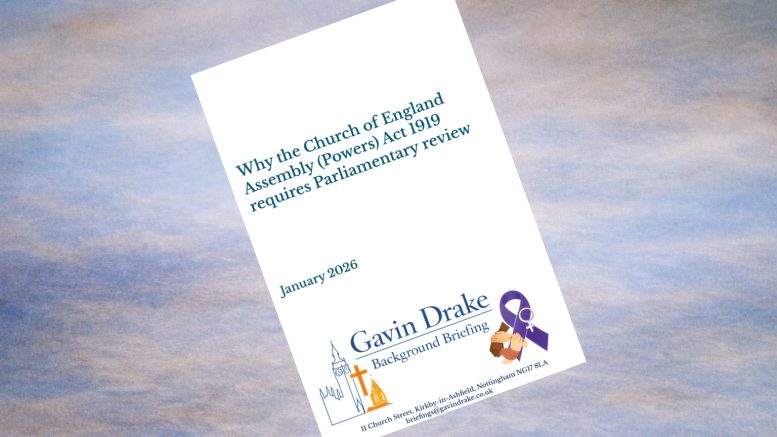
One of the least understood – and most consequential – features of the Church of England is the way its legislation becomes law.
Measures passed by the General Synod do not remain internal church rules. Once approved by Parliament, they have the same legal force as Acts of Parliament. They can shape safeguarding systems, disciplinary regimes, rights of access to information, and the treatment of victims and survivors.
Yet Parliament does not scrutinise these Measures in the way it scrutinises Bills.
This is not because Parliament chooses not to. It is because the Church of England Assembly (Powers) Act 1919 does not allow it to.
My first background briefing explains why that matters.
The 1919 Act created a constitutional settlement that reflected the assumptions of a very different era. Under it, Parliament may approve or reject a Measure, but it may not amend it. It may identify defects, but it may not require them to be corrected. Even when serious concerns are raised, Parliament’s only option is an all-or-nothing decision.
Worse still, the Act restricts transparency. A Parliamentary committee examining a Measure cannot necessarily publish its conclusions independently. In effect, an external body – the Church of England – is placed in a position of controlling whether and how Parliament’s concerns are made public.
That is constitutionally extraordinary.
This briefing does not argue that Parliament should rewrite ecclesiastical legislation. It does not trespass into theology. What it does is set out, carefully and factually, how the current framework limits democratic accountability, and why those limits have real consequences.
In particular, it explains how safeguarding and disciplinary systems have been enacted with the force of statute, while being insulated from the normal corrective processes that apply to other legislation.
If you want to understand why Parliament keeps approving legislation it cannot fix – and why “scrutiny” in this context often amounts to little more than observation – this briefing provides the necessary background.
It is written to be durable, accessible, and usable.


Be the first to comment on "Why the Church of England Assembly (Powers) Act 1919 needs urgent review"