See also: Stephen Cottrell’s own words — and why they fail basic safeguarding and legal tests
See also: Authority invoked, lessons avoided: what the Archbishop of York’s statement still fails to confront
And if you want a good reminder of the case, listen to BBC Radio’s original File on Four investigation
The Church of England is currently engaged in two distinct processes arising from the David Tudor case. One is a disciplinary complaint brought under the Clergy Discipline Measure against the Archbishop of York, Stephen Cottrell, which was halted at a preliminary stage by the President of Tribunals under section 17 of the Measure. The other is a national, independent Safeguarding Practice Review, still ongoing, examining the Church’s handling of the case over many years and intended to identify learning to improve safeguarding practice and outcomes for victims and survivors.
The Safeguarding Practice Review (SPR) was commissioned by the National Safeguarding Team and the dioceses of Chelmsford and Southwark to examine the Church’s handling of the David Tudor case over many years. Its terms of reference make clear that Stephen Cottrell’s actions will be part of the review. The review began work in March 2025 and was originally expected to conclude within six months. A final call for evidence was issued in September 2025, after that initial timetable had already elapsed, and in November the Church announced a further delay, citing new police information.
The review is now expected to report in early 2026. Its stated purpose is not to re-litigate disciplinary findings, but to identify learning, assess safeguarding practice and decision-making, and improve outcomes for victims and survivors. At the time the Archbishop issued his statement, this review was ongoing and unfinished.
These two processes serve different purposes and operate to different standards. A Section 17 decision determines only whether a complaint proceeds to a tribunal; it does not make findings of fact after a hearing, and it does not exhaust wider questions of safeguarding leadership, institutional learning, or systemic failure. The difficulty with the Archbishop’s public statement following the Section 17 decision is not its timing, but the way it sought to present that procedural outcome as a point of closure while the broader safeguarding review remains unfinished.
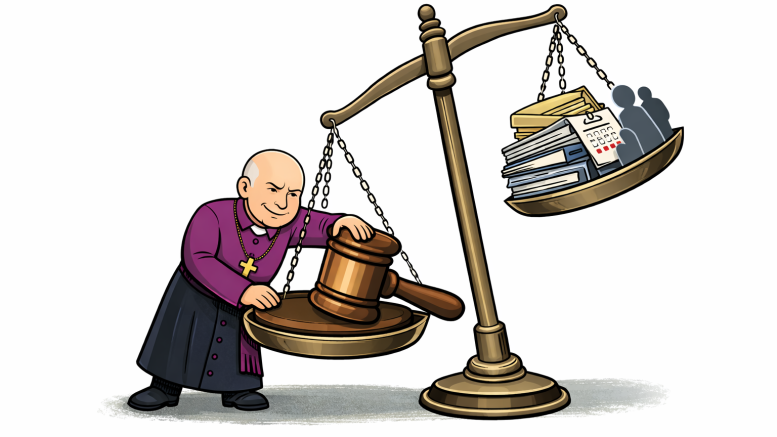
By framing the Section 17 decision as definitive, and by invoking senior judicial authority — emphasising that the President of Tribunals is also a judge of the Court of Appeal — to reinforce that framing, the Archbishop’s statement did more than explain a procedural outcome. It shaped how that outcome would be understood — and, crucially, how it would be reported — at a point when a wider safeguarding process remains unfinished.
That risk was not theoretical. It materialised almost immediately in media coverage of the Archbishop’s statement. Within hours, mainstream outlets reported the outcome as a substantive exoneration. The Guardian ran the headline “Archbishop of York cleared of misconduct over handling of sexual abuse case”. Premier Christian News used“Archbishop of York cleared over handling of abuse case”. The Church Times headlined: “President of Tribunals finds no case to answer for Archbishop of York in David Tudor case”.
That framing did not arise from the President’s decision itself, which stopped the complaint at a preliminary stage and expressly acknowledged serious mistakes and regrettable decisions. It flowed from the Archbishop’s own characterisation of the outcome. The danger identified above — that a Section 17 threshold decision would be treated as final vindication, and would dominate the public narrative while a Safeguarding Practice Review remains ongoing — therefore moved rapidly from risk to reality.
Respect for the independent reviewer
It is important to be clear about what this critique is not. It is not a criticism of the independent Safeguarding Practice Review or of the reviewer herself. Sue Williams is a former senior police commander, appointed precisely because of her professional independence, experience, and credibility. The Terms of Reference make clear that the review is designed to examine evidence, identify good and poor practice, and apply professional judgment on the balance of probabilities in order to improve safeguarding outcomes.
There is no reason to doubt the reviewer’s integrity or competence. The concern lies elsewhere: in the institutional context in which she is being asked to work, and the signals being sent publicly by the Church’s most senior leaders while her work is ongoing.
Two foreseeable risks created by the statement
The Archbishop’s statement creates two distinct and foreseeable risks, both of which are grounded in recent Church experience rather than speculation.
First, the risk of dampening critique.
When a senior leader publicly frames a Section 17 decision as definitive exoneration, and explicitly associates that outcome with the authority of a senior judge, it inevitably raises the stakes for anyone who later offers criticism. An independent reviewer, however robust, cannot be unaware that any adverse findings may be portrayed as contradicting what has already been presented to the public as a quasi-judicial clearance. That does not mean the reviewer will soften conclusions — but it does mean the institutional climate has been made more difficult than it needs to be.
Second, the risk of delegitimising the review’s findings if they diverge.
This risk is not hypothetical. Following the publication of the Makin Review in the John Smyth case, there were public attempts by figures linked to the Archbishops’ Council and the National Safeguarding Team to question, contextualise, or resist aspects of the findings — particularly where they touched on reporting failures and senior responsibility. That experience shows how quickly review findings can be contested when they are uncomfortable.
By issuing a statement that strongly asserts “no possibility of misconduct”, the Archbishop has inadvertently provided ammunition for supporters to challenge the SPR’s conclusions if they are critical. If the review identifies failures in leadership, decision-making, or safeguarding culture, the response may not be “what can we learn?”, but “how can this be right if a senior judge said otherwise?”.
That dynamic undermines the very purpose of a Safeguarding Practice Review.
Narrative closure versus safeguarding humility
There is also a deeper problem of leadership judgment.
The Archbishop’s statement could have taken a different tone. It could have said, in effect: this is an interim procedural decision; serious concerns remain; an independent safeguarding review is ongoing; I will listen carefully to its findings. Instead, the statement prioritised reassurance — to himself and to the institution — over restraint.
That choice matters because safeguarding leadership demands humility in uncertainty. When processes are ongoing, particularly those designed to learn from harm, leaders are expected to resist the urge for premature validation. In this case, the Archbishop chose language that effectively said “I am in the clear”, rather than “this is one step, and more scrutiny is to come”.
The victims and survivors are once again placed second. Their experiences are acknowledged in words, but subordinated in practice to the need to assert reputational closure.
A continuing failure to grasp the structural problem
Most troubling of all is what the statement again fails to address: the structural safeguarding failure at the heart of the Tudor case.
The Archbishop repeats the claim that there was “no power” to remove David Tudor earlier. Yet he offers no recognition that this remains a live safeguarding defect, nor any indication that he intends to do anything about it. A bishop still cannot remove a priest in circumstances of known safeguarding risk. That is not merely a historical curiosity; it is a present danger. A Safeguarding Practice Review is precisely the mechanism through which such systemic failures should be confronted.
By presenting the disciplinary outcome as effectively final, the Archbishop’s statement diminishes the space for that necessary structural reckoning.
Another red flag — and a necessary conclusion
None of this requires an allegation of bad faith. But safeguarding is not assessed by intention alone. It is assessed by judgment, awareness, and the ability to place institutional learning and survivor wellbeing ahead of personal validation.
In that respect, this statement is another red flag. It shows a continuing tendency to conflate procedural outcomes with moral clearance, to close narratives prematurely, and to underestimate how power and messaging affect safeguarding processes still in train.
For a leader already criticised for failures of curiosity, reflection, and structural action, this is not a minor misstep. It is part of a pattern.
Safeguarding credibility depends not only on what leaders say, but on what they choose not to say while others are still doing the work of truth-finding. On that measure, the Archbishop’s statement falls short — and reinforces the case that his position is no longer tenable.
Leadership that repeatedly places reassurance before accountability cannot deliver a safer Church. At this point, the only responsible course left is resignation.




‘The abuse survivors calling on archbishop of York to resign’ by File-on-4 (Radio 4) exposed very poor practice. Did Cottrell very clearly undermine his own credibility and professionalism by not resigning?