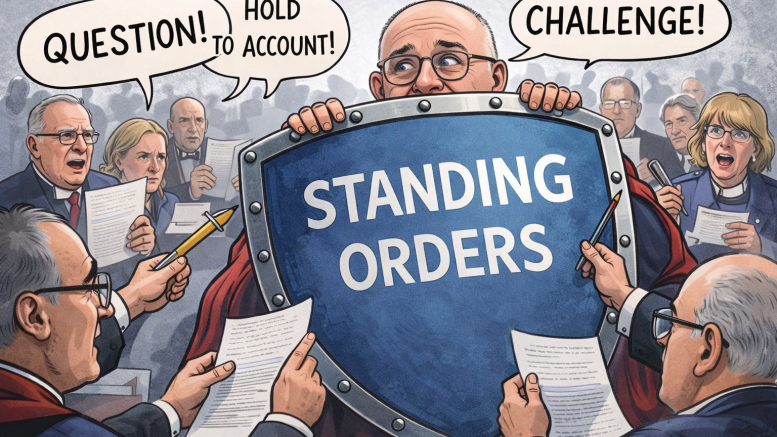
Last February’s General Synod showed, in stark and unprecedented terms, how fragile confidence in the Church of England’s senior leadership has become. At the start of the Group of Sessions, Sam Margrave attempted to prevent the Archbishop of York, Stephen Cottrell, from delivering a Presidential Address.
This was not a fit of personal animus. Stephen Cottrell was — and remains — at the centre of multiple safeguarding, leadership, and governance failures. Many people, me among them, have called for his resignation. But “Teflon Stephen” refuses to go.
The Standing Orders provide a number of procedures for General Synod members to stop an item of business. The most common is a procedural motion to “move to next business”. That motion would almost certainly have been challenged by the Synod’s legal adviser if used against a Presidential Address. While not explicitly ruled out by the current Standing Orders, the limits on when it may be used implicitly mean that it could not be deployed in that context.
So Sam Margrave wisely chose another route: the suspension of Standing Order 119 — the Standing Order that makes provision for Presidential Addresses. Suspend that Standing Order, and there is no Presidential Address.
The attempt failed. By a counted vote of the whole Synod, 73 members voted in favour of stopping the address, 239 voted against, with 43 abstentions. The Archbishop therefore spoke. But the numbers matter.
A vote of 73 Synod members willing to take the extraordinary step of seeking to block a Presidential Address, together with a further 43 unwilling to support it, represents a significant and entirely unprecedented expression of no confidence in an Archbishop by the Church’s General Synod — just under a quarter of the Synod indicating opposition or withholding support. That should have been a warning light. Instead, the Church’s leadership brushed it off and carried on regardless.
It is against that background that the Standing Orders Committee’s proposed amendment to Standing Order 33 must be judged. The change would make explicit what was previously implicit: that a motion for “Next Business” may not be moved on a Presidential Address or the questions that follow it.
In substance, it locks in protection for archbishops at the very moment Synod has demonstrated a willingness to challenge them. At a time when trust in the Church of England — and in Stephen Cottrell personally — is at a low ebb, that looks less like tidying up procedure and more like circling the wagons.
The way this is being done compounds the problem. The Business Committee has determined that the amendment will be deemed approved unless five members spot it, object, and force a debate. That is no small ask when Synod members are already required to plough through more than 900 pages of GS and GS Misc papers — nearly 350,000 words — before even reaching the notice papers, where this proposal is buried.
Expecting members to catch and contest a constitutional tightening of their own powers under those conditions is not transparency; it is procedural stealth.
The handling of last year’s motion only sharpens the concern. The Chair of that session, the Bishop of Dover, Rose Hudson-Wilkin, chose not to allow debate on the procedural motion. She was entitled to do so under the Standing Orders — but she then proceeded to offer her own extended intervention, invoking Scripture and prayer, and downplaying questions of consequence by appealing to biblical examples of flawed leaders.
I have nothing personal against Bishop Rose — she was the first person I interviewed when I was 14 and volunteering on a church-event newsletter — but the way she handled Sam Margrave’s motion was wrong.
Many members experienced her intervention not as neutral chairing, but as a spiritually-abusive weighted rebuttal of a procedural challenge, delivered by someone who had just ruled that no debate should take place.
At such a moment, the instinct of Church leadership should be to open itself further to scrutiny, not to narrow the space in which it can be exercised. Other Synod members enjoy no comparable “safety blanket”. They can be interrupted, curtailed, or procedurally challenged. Archbishops, it seems, must not be. If Standing Orders are to be amended, they should move in the opposite direction: towards reducing disparities of power, not entrenching them. Accountability cannot be something the Church merely preaches. It must also be something its leaders are willing to face — in the chamber, in public, and without procedural insulation.



Leave a comment