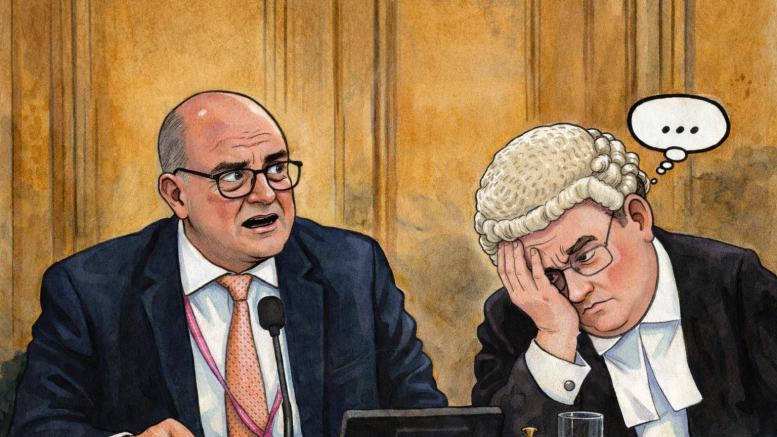
I have already written about the substance of the two safeguarding-related questions put to the Presidents of the Archbishops’ Council at General Synod. What now needs addressing is something more troubling: the decision by the Chair of the Question Time session to interrupt and halt an answer that was plainly becoming uncomfortable. I have prepared a transcript of the two questions, which you can download here.
The moment of interruption deserves scrutiny in its own right, because it goes to the heart of accountability, transparency, and how far — or how little — the Church’s national leadership is prepared to permit open examination of its relationship with the Charity Commission.
The ruling — and the reason given
The supplementary question from Sue Lucas was straightforward. She asked whether the expectations the Charity Commission places on trustees — in this case in relation to safeguarding — apply in the same way to Parochial Church Councils as they do to diocesan boards of finance and the Archbishops’ Council.
Canon Alison Coulter began to answer. She said, correctly, that her understanding was that these expectations apply to all trustees, and that the Charity Commission is clear about this in its published guidance. She then added that conversations were ongoing.
At that point, the Chair intervened and ruled the question out of order, stating that it was “a question seeking legal advice”.
The ruling is final. That is not in dispute. But the reason given matters, because it reveals much about the institutional instincts now at play.
Was this really “seeking legal advice”?
On any ordinary understanding, the answer is no.
The question did not ask for a legal opinion on the interpretation of statute. It did not ask how a court would rule, or whether a particular body would be legally liable in a given scenario. It asked whether the Archbishops’ Council understands the Charity Commission’s expectations to apply equally across Church charities.
That is a governance and accountability question, not a request for legal advice. Synod routinely asks — and is routinely answered — questions about legal duties, regulatory frameworks, trustee responsibilities, and compliance obligations. If merely touching on law were enough to render a question out of order, a large proportion of Synod’s safeguarding scrutiny over the past decade would never have been permitted.
Nor does the Standing Orders language support such an expansive prohibition. The relevant clause prevents questions that ask for “an expression of opinion on a question of law”. Sue Lucas’s question did not do that. It asked about institutional understanding and regulatory expectations. Those are not the same thing.
Indeed, Canon Coulter’s partial answer demonstrated precisely how the question could be answered without straying into legal opinion at all.
A ruling that stopped an answer, not a question
What is striking is that the interruption did not come immediately. It came after the answer had begun, and at precisely the point where it was moving beyond safe generalities and towards the reality of the Archbishops’ Council’s engagement with the regulator.
That strongly suggests that the practical effect — if not the formal framing — of the ruling was to stop the answer, not to exclude the question. The ruling functioned as a protective interruption, not an application of a defined Standing Order rule.
I cannot know what prompted the intervention. But anyone familiar with Synod procedure will recognise the pattern: Chairs almost never deploy Standing Orders mid-answer without prompting. In practice, such interventions are usually made on advice from the legal assessor sitting beside the Chair.
In this case, that assessor is a barrister employed by the Archbishops’ Council, Edward Dobson. The Chair himself, Stephen Hofmeyr, is a senior and highly experienced KC, selected by the archbishops as part of the panel of Synod Chairs. That context matters. It does not prove anything improper, but it does raise legitimate questions about institutional reflexes when scrutiny sharpens.
Why this answer, at this moment?
It is worth asking why this particular line of questioning might have been seen as risky.
The Archbishops’ Council is currently under a Regulatory Action Plan imposed by the Charity Commission. One of the Commission’s concerns — expressed not only in relation to the Council, but also in findings concerning dioceses — is that the Church has failed to apply ordinary safeguarding expectations where adults are not assessed as “vulnerable”.
That concern rests squarely on the Commission’s understanding of normal trustee duties. Duties that apply to all charities, religious or otherwise.
Yet in response to Mrs Allotey’s written question, the Archbishops’ Council said that it had written to the Charity Commission seeking a discussion on what changes may be needed. That language is revealing. If expectations are clear and accepted, there is nothing to “seek a discussion” about. You comply.
The obvious inference — and I stress that it is an inference — is that the Council is exploring whether ecclesiastical law, or the Church’s peculiar structures, might justify a different application of charity law duties. In other words, whether Church of England charities can or should be treated differently from other charities when it comes to safeguarding obligations.
That is a weak argument. Charity law does not evaporate at the church door. Trustees are trustees. But it is precisely the sort of argument that becomes awkward if stated plainly in open Synod.
The inconsistency that should worry Synod
This brings us to the earlier exchange with Dr Brendan Biggs.
Asked about the Regulatory Action Plan, Canon Coulter sought to minimise its significance, saying there was “nothing in it that wouldn’t be surprising to Synod” and that it was “all work that you know about”.
That cannot be right.
The Charity Commission does not issue Regulatory Action Plans to ask charities to carry on doing what they are already doing. Such plans are, by definition, corrective. They identify failures, gaps, or deficiencies and require concrete remedial action.
If Synod already “knew about” the work, why had it not been done? If it had been done, why was a Regulatory Action Plan necessary?
Canon Coulter also told Dr Biggs that the Archbishops’ Council “continue[s] to meet and work regularly with the Charity Commission”. Yet, in answer to Mrs Allotey, the Council said it had written seeking a discussion about concerns raised in November 2025 — three months earlier.
That is not what “meeting and working regularly” looks like. It looks like delay.
Why this matters
The interruption of Sue Lucas’s supplementary question matters because it shut down precisely the line of inquiry Synod most needs to pursue: whether the Archbishops’ Council is fully accepting the Charity Commission’s view of trustee duties, or whether it is attempting — quietly and behind closed doors — to negotiate exceptions.
Synod is entitled to know that. Survivors are entitled to know that. The public is entitled to know that.
I am not alleging conspiracy. I am not accusing individuals of bad faith. But patterns of behaviour matter, and so do instincts. When scrutiny tightens, does the institution lean into transparency — or does it reach for procedural shields?
On this occasion, the shield was labelled “seeking legal advice”. It does not withstand serious examination. The Chair’s ruling stands. But the questions it suppressed do not go away.


Leave a comment